Comparisons
In-house vs. outsourced contact center: which to choose
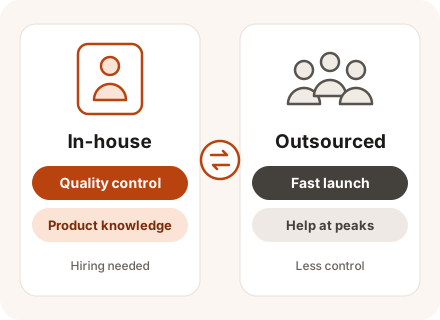
An in-house contact center gives you full control over quality and data. An outsourcing partner gets you started faster and absorbs peaks more easily, but it's harder to oversee the work directly, and customer data often stays in the vendor's system. You can combine the two: on the CONTACT.WORK platform, your team and the vendor's agents work in the same system.
In brief
Key takeaways
- Go in-house when quality oversight, data, and deep product knowledge matter most.
- Outsource when you need to launch fast or get through peaks without extra hiring.
- You can combine the two: your team handles key accounts, the vendor takes peaks and night shifts.
Criteria
Side-by-side comparison
| Criterion | In-house | Outsourced |
|---|---|---|
| Quality oversight | Direct: you hire and train the agents | Only through contract terms and reporting |
| Product knowledge | Deep, and it stays in the company | Depends on the vendor's training |
| Time to launch | Longer: hiring, training, setup | Faster, if the vendor has agents available |
| Costs | Salaries, workstations, platform support | Billed per hour, per contact, or per agent |
| Handling peaks | Limited to your own headcount | The vendor adds agents |
| Customer data | Stays with you | Goes to the vendor if they work in their own system |
| Reporting | Full access to all data | Whatever the contract specifies – or everything, if the vendor works in your platform |
| Management workload | High: schedules, quality, turnover | Lower: you manage the vendor |
| Complex questions | Handled well: agents know the product | Better suited to standard, scripted questions |
How to choose
When to choose which
When to go in-house
An in-house team fits when you want to own every customer conversation yourself.
- Customer questions are complex, and answering them takes solid product knowledge.
- Customer data must not leave your systems.
- Customer service is your competitive edge.
- Volume is steady and large enough to keep a permanent team busy.
When to outsource
Outsourcing fits when speed and flexibility matter more than direct control.
- You need to start serving customers before you can build a team.
- Volume spikes sharply during the season or during campaigns.
- Questions are standard and well covered by scripts.
- You need night shifts or other languages and don't have agents for them.
Requirements
What it takes to launch
To launch your own contact center, you'll need:
- Agents and a shift supervisor – headcount is calculated from your volume.
- Somewhere to run the system: the CONTACT.WORK cloud or your own servers.
- Telephony: phone numbers and voice lines (a SIP trunk).
- A knowledge base and call scripts to train your agents.
- Workstations – in the office or at home, with a browser-based softphone.
Combining
How to combine them or switch
In a blended model, your own team handles key accounts and complex questions, while the vendor takes peaks, night shifts, or outbound campaigns. When both teams work in one platform, recordings, chats, and reports stay with you, and quality is scored the same way for everyone. If you decide to bring the contact center back in-house, do it gradually:
- We measure current volume, handle time, and service level.
- We calculate the number of agents you need and plan hiring and training.
- We launch the platform and integrations before your first agents start.
- We shift the volume in stages, starting with one line or channel.
- We keep the vendor for peaks until your team can handle the full load.
Q&A
Frequently asked questions
What's the core difference between an in-house and an outsourced contact center?
In-house, the agents are your employees: you hire, train, and supervise them. With outsourcing, the vendor's agents handle your calls and chats, and you pay for the service and monitor quality under the contract.
Is outsourcing cheaper than an in-house contact center?
Not always. Compare the full cost: for in-house, that's salaries, workstations, platform support, and turnover; for outsourcing, it's the service fee plus the time spent managing the vendor. With steady volume and complex questions, an in-house contact center often costs less over time, while outsourcing pays off for peaks and standard questions.
Can the vendor's agents work with us in the same platform?
They can. They work alongside your team in a shared CONTACT.WORK platform, and recordings, chats, and reports stay with you.
What if the vendor insists on using its own system?
Then you can require the vendor to send call results to you through the API. That way you see their calls in your platform, can listen to recordings, and can build reports. Most importantly, each customer's full communication history stays in your platform, so you can keep working with it.
How do we monitor the vendor's quality?
Put clear metrics in the contract – service level, first contact resolution, customer satisfaction – and get access to the recordings. Speech analytics lets you review every call rather than a sample (it requires the agent and the customer to be recorded on separate channels).
Can CONTACT.WORK launch a contact center for us?
We launch contact centers end to end – platform, telephony, integrations, and training – and support them after launch.
Glossary
Terms on this page
- BPO (business process outsourcing)
- Part of the company's work, such as customer service, is handed to an outside provider. Learn more →
- Softphone
- A phone app that runs on a computer or in a browser. Learn more →
- Workforce management (WFM)
- Workload forecasts and agent shift schedules. Learn more →
- Supervisor
- Leads a team of agents: watches the queue and quality, helps and coaches. Learn more →
- Service level (SL)
- The share of calls answered within a set time – for example, 80% in 20 seconds. Learn more →
- Erlang C formula
- Tells you how many agents you need so customers don't wait longer than they should. Learn more →
- Cloud deployment (cloud)
- The platform runs on the vendor's servers, and agents connect over the internet. Learn more →
- On-premises deployment
- The system runs on the company's own servers, not in the vendor's cloud. Learn more →
- SIP trunk
- A phone line from the carrier over the internet instead of a wire. Learn more →
- SIP (Session Initiation Protocol)
- The protocol that sets up calls in IP telephony. Learn more →
- Knowledge base
- All answers, policies, and prices in one place – for agents and AI. Learn more →
- Call script
- A call playbook: what to say, what to ask, and how to handle objections. Learn more →
- Support tiers
- A support tier: tier 1 handles common issues, tier 2 handles complex ones. Learn more →
- API (application programming interface)
- The way programs exchange data with each other without a person in the loop. Learn more →
- FCR – first contact resolution
- How many issues get resolved the first time, so the customer doesn't have to call again. Learn more →
- Speech analytics
- The system analyzes recorded calls automatically: topics, script adherence, customer emotions. Learn more →
Updated: