Comparisons
Power vs. predictive dialer: a comparison for contact centers
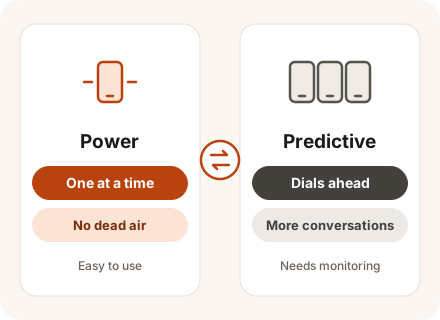
A power dialer calls the next number once an agent is free, so the customer hears an agent right away. A predictive dialer calls several numbers ahead of time and cuts agent idle time, but after answering, customers may hear a pause or hang up before an agent joins. The CONTACT.WORK auto dialer has both modes, and you pick the mode for each campaign.
In brief
Key takeaways
- Use a power dialer when every conversation counts: the customer hears an agent right away.
- Use a predictive dialer when the list is large, contact rates are low, and you have many agents.
- You can run both modes at the same time – in different campaigns.
Criteria
Side-by-side comparison
| Criterion | Power dialer | Predictive dialer |
|---|---|---|
| How it dials | The next number, once an agent is free | Several numbers ahead, based on a forecast of how many agents will be free soon |
| Agent idle time | Some – the agent waits for the customer to pick up | Almost none |
| Abandoned calls | Almost none | They happen, and the rate has to be monitored |
| What the customer hears | An agent, right after answering | Sometimes a pause, silence, or hold music |
| List size | Any | Large |
| Team size | Works for small teams too | Needs enough agents for the forecast to be accurate |
| Type of contacts | Existing customers, warm leads, service calls | Cold lists, high-volume campaigns |
| Day to day | Easy to use | Requires tuning the dialing pace and monitoring the campaign |
| Answering machine detection | Saves agents' time | Essential – otherwise the dialing pace is calculated wrong |
How to choose
When to choose which
When to choose a power dialer
A power dialer fits when conversation quality matters more than calls per hour.
- You call existing customers: reminders, confirmations, service calls.
- You qualify high-value leads.
- Your team is small.
- You're moving from manual dialing to automated dialing for the first time.
- You have a limited number of phone lines.
When to choose a predictive dialer
A predictive dialer fits when the list is large and few people pick up.
- You have a large cold list where most calls go unanswered.
- At least 30 agents work the campaign – that's when the forecast of how many will be free soon is accurate.
- Conversations are short and similar: surveys, simple offers.
- A supervisor monitors the dialing pace and abandoned calls.
Requirements
What it takes to launch
Both modes need the same things:
- A contact list – from a file, your CRM, or another system through the API.
- Phone lines (a SIP trunk) for the number of simultaneous calls you need.
- A call script and the call dispositions agents select.
- Answering machine detection – required in predictive mode.
- For predictive mode, at least 30 agents on one campaign.
Combining
How to combine them or switch
You choose the mode for each outbound campaign. Warm callbacks go out in power mode, large cold lists in predictive mode. Simple scripted calls, such as reminders, can go to a voice AI agent, leaving agents the conversations that need a person.
- We start a new list in power mode and see how many customers pick up and how long conversations last.
- We tune answering machine detection on real calls.
- For a large list and a big enough team, we switch on predictive mode.
- We watch abandoned calls and agent idle time; if abandoned calls go up, we go back to power mode.
- You can set the mode to adjust automatically: power dialing on lists that respond well, predictive dialing on lists that don't.
Q&A
Frequently asked questions
How is a power dialer different from a predictive dialer?
A power dialer calls when an agent is already free. A predictive dialer calls ahead, expecting an agent to be free by the time the customer answers.
Are there legal limits on auto dialing?
In the US, the TCPA requires the recipient's prior consent for automated and prerecorded marketing calls, calls are allowed only from 8:00 AM to 9:00 PM in the recipient's time zone, and numbers on the National Do Not Call Registry must be excluded. This applies to both modes. Keep your abandoned call rate low too: a customer who hears silence or hold music often won't pick up next time. Check the specifics with your legal counsel.
How do we reduce abandoned calls?
A few techniques keep the customer on the line until an agent joins – for example, realistic contact center background noise or a greeting from an AI agent.
What is answering machine detection for?
Without it, agents waste time listening to voicemail greetings or silence, and in predictive mode it also throws off the dialing pace calculation.
Can we run a predictive dialer with a small number of agents?
You can, but customers will wait longer for a free agent to join the call, so the abandoned call rate will be high.
Can a voice AI agent replace an auto dialer?
For simple scripted calls like reminders and confirmations, the AI agent can make the calls itself. For sales and complex conversations, the auto dialer still connects customers to agents.
Glossary
Terms on this page
- Power dialer (progressive dialer)
- As soon as an agent is free, the system dials the next number on the list. Learn more →
- Predictive dialer
- The system dials numbers in advance, predicting when an agent will be free. Learn more →
- Abandonment rate
- How many callers hang up before an agent answers. Learn more →
- Answering machine detection (AMD)
- Tells whether a person or an answering machine picked up an outbound call. Learn more →
- CRM – customer relationship management
- Where a company keeps its customers, deals, and full communication history. Learn more →
- Voicemail
- A recorded message when the person does not pick up. Learn more →
- API (application programming interface)
- The way programs exchange data with each other without a person in the loop. Learn more →
- Callback
- The customer doesn't wait on hold but asks for a callback – and gets one when an agent is free. Learn more →
- Supervisor
- Leads a team of agents: watches the queue and quality, helps and coaches. Learn more →
- SIP trunk
- A phone line from the carrier over the internet instead of a wire. Learn more →
- SIP (Session Initiation Protocol)
- The protocol that sets up calls in IP telephony. Learn more →
- Call script
- A call playbook: what to say, what to ask, and how to handle objections. Learn more →
- Automatic callback
- The system calls back everyone who couldn't get through. Learn more →
Updated: